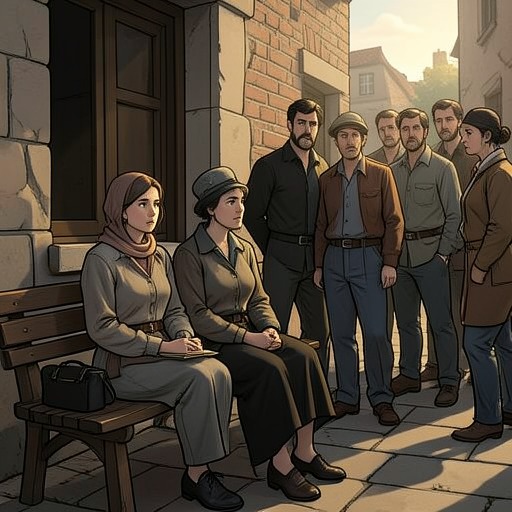
Deissy
Of Fates & Fables (The Complete Series)Deissy is a witch associated with Birdie’s coven and an important, if briefly presented, figure in the protection of Brody’s rescued captives. Her decisive contribution is a cloaking spell that conceals the women and children from further pursuit, extending the rescue beyond extraction and into the difficult work of keeping survivors safe.
Identity and Introduction
Deissy is introduced as one of two women who arrive with Birdie to support the resistance against Regina and Brody. Birdie identifies her alongside Mirabelle as a member of her coven, distinguishing the group from the werewolf pack and showing that the coming conflict draws assistance from several supernatural communities. Deissy is described as younger than Birdie, with dark hair and dark eyes, while Mirabelle is presented as an older woman with graying hair worn in a braid. Their smiles and introductions give the coven a composed, purposeful presence amid preparations for war.
Deissy’s characterization is defined less by personal history than by competence. Birdie brings her not merely as a fighter but as someone able to handle the practical problem of concealment. This places Deissy within the logistical infrastructure of resistance: she helps solve what happens after the captives have been found, when visibility itself becomes a danger.
The Captives and the Need for Protection
Deissy’s intervention responds to the consequences of Brody’s breeding operation. The missing campus girls are revealed to have been turned into werewolves and forcibly made pregnant so that Brody could produce new pack members. Missy explains that the women may have been moved elsewhere because the room where they were expected to be found was empty, confirming that the captives were being relocated or hidden as part of the operation. When the rescue party finally finds them, the women are visibly pregnant, frightened, and marked with tattoos matching Brody’s.
The marks extend Brody’s control beyond the adult captives. One rescued woman reveals a baby wrapped in fabric, and a dark tattoo is visible on the infant’s arm. The infant has already been claimed by Brody’s system, making the children part of the same political and bodily struggle rather than an incidental consequence of it. Deissy’s spell therefore protects an entire vulnerable population: women whose bodies have been commandeered for reproduction and children born into a regime that treats them as property.
Magical Protection and Resistance
Birdie explains that Deissy can cloak both the girls and whatever location is chosen to hide them. The wording makes the spell flexible and practical. It is not limited to disguising a person in motion; it can also render a refuge harder to detect, allowing the rescuers to choose safety according to circumstances. Deissy is then sent with Danielle to assemble the other women, directly connecting magical preparation with survivor care.
This work gives Deissy a role in the transition from raid to sanctuary. The women need more than physical removal from Brody’s control. They need a place where their presence cannot immediately expose them to renewed capture, and where the rescued babies will not become signals leading Brody back to them. Cloaking converts concealment into a protective resource and helps create the conditions under which the survivors can begin to recover their agency.
Her contribution also broadens the meaning of resistance in the narrative. The conflict is not resolved by defeating an enemy in combat alone. It requires transport, medical attention, concealment, collective organization, and the defense of people whose bodies have been used as instruments of territorial expansion. Deissy’s magic belongs to this less spectacular but essential dimension of the struggle.
Relation to the Recovery of the Survivors
The rescued women remain marked by the violence they endured. Their short hair and neck tattoos make the history of their captivity visible, while their pregnancies embody the continuing consequences of Brody’s coercion. Kaitlyn later insists that gratitude for rescue must not erase the fact that her pregnancy and her circumstances were never freely chosen. She refuses to surrender her baby, Hunter, but also demands that Brody and the werebros answer for what they did. Her position separates survival from consent: making a life within terrible circumstances does not make the original violence voluntary.
Deissy’s cloaking spell supports that distinction by protecting the survivors without defining them solely through their victimization. The spell does not undo the tattoos, the pregnancies, the lost opportunities, or the trauma. It provides a material condition for choice: safety from immediate discovery. In that sense, Deissy’s role is aligned with a survivor-centered form of care. Protection is not presented as ownership or command, but as an intervention that helps the women and children remain beyond Brody’s reach.
Danielle’s presence in the same sequence further links Deissy’s work to the broader consequences of Brody’s actions. Danielle has already lost her education and medical ambitions because she cannot control her new werewolf form after being attacked and turned. The women rescued from Brody likewise face lives reorganized by forced transformation and pregnancy. Against these losses, Deissy helps build a protective network in which supernatural power is used to preserve people rather than possess them.
Narrative Role and Significance
Deissy is a supporting character whose narrative importance comes from function rather than extended interior development. She represents the practical, communal side of magical resistance and demonstrates that the alliance opposing Brody includes witches as well as werewolves and human allies. Her presence also makes the rescue operation structurally complete: Birdie confronts Regina, while Deissy and Mirabelle provide specialized assistance that keeps the rescued group hidden.
The contrast between Deissy’s magic and Brody’s tattoos is especially significant. Brody’s markings impose ownership on women and infants, making the body a record of domination. Deissy’s cloaking, by contrast, uses supernatural power to withdraw bodies from surveillance and possession. One form of magic exposes and claims; the other conceals and safeguards. The difference captures the larger moral conflict between Brody’s forced reproduction and the resistance’s effort to restore autonomy.
Deissy’s final significance lies in this movement from rescue to refuge. The battered survivors, the babies marked before they can choose anything for themselves, and the ongoing threat of Brody’s retaliation all show that liberation cannot end at the moment of escape. By helping hide the girls and the place where they will be sheltered, Deissy turns a temporary victory into a defensible future. Her brief appearance thus contributes to the book’s larger image of chosen family: safety is made collectively, through skills, alliances, and care placed in the service of those who have been denied choice.